News & Events
週間ニューヨーク生活 2026年9月24日掲載
剣道のN Y士道館に在外公館長表彰
文化継承と日米友好に貢献
第36回グレーターノースイースタン米国剣道連盟(GNEUSKF)剣道大会が9月20日、ニューヨーク州パーチェスの慶應義塾ニューヨーク学院で開催され、17の道場および大学・高校の剣道クラブから130人を超える剣士が参加した。
大会には、在ニューヨーク日本国総領事の片平聡大使が来賓として出席し、開会式で挨拶した。あわせて、グレーターノースイースタン米国剣道連盟の中心道場である志道学院ニューヨーク士道館(加藤彰三館長)に対し、長年にわたる活動を称え在外公館長表彰が行われた。
表彰状では、同道場が1982年の創設以来長年にわたり剣道・居合道の普及と次世代の人材育成に尽力するとともに、日本文化の普及促進や大会運営等を通じて日米両国民の相互理解や友好関係の促進にも大きな役割を果たしてきたことが高く評価された。
また今大会には、日本から警視庁前主席師範の梯正治・範士八段と、警視庁前師範で東京武道館師範の石井猛・範士八段が来米し、それぞれ審判長、副審判長を務めた。両氏は長年にわたり日本剣道界の第一線で活躍してきた指導者であり、その指導と助言は参加者にとって大きな励みとなったようだ。
会場では、真剣勝負の中にも礼節を重んじる武道精神が随所に見られ、試合後には所属道場の枠を超えて互いの健闘を称え合う姿が見られた。長年にわたり北東部地域で育まれてきた剣道を通じた交流と友情、そして日本文化の継承を象徴する一日となった。
表彰を受けたNY士道館の加藤館長は「このたび、このような名誉ある表彰を賜り、身に余る光栄です。剣道を始めて60年、ニューヨークに道場を開いて40年以上、多くの先生方、仲間、門下生、そして支えてくださった皆様のお力があって今日があります。この表彰は私個人ではなく、皆様と共に頂いたものと受け止めています。心より感謝するとともに、これからも剣道を通じて日本文化とその精神を次の世代へ伝えていきたいと思います」と喜びを語った。
大会戦績結果は次の通り
大会では少年から高段者まで幅広い年代の剣士が熱戦を展開した。
個人戦(少年・学生)
| 9歳以下の部 | Ryan Sohn(GSK) |
| 10〜12歳の部 | Tomohide Sato(志道学院ニューヨーク士道館) |
| 13〜15歳の部 | Akihiro Yonekawa(Cherry Hill Kenyukai) |
| 女子13〜18歳の部 | Suzuha Winters(NY Kenshinkai) |
| 高校・大学生の部 | Lucas Jeong(Chung Pa Kendo Dojo) |
個人戦(一般)
| 女子の部 | Eri Kosakaya(Brooklyn Kenyukai) |
| シニアの部 | Shinichiro Fukui(NY Kenshinkai) |
| 初段以下の部 | Suho Lee(Chung Pa Kendo Dojo) |
| 二段から四段の部 | Kyoyuki Shiono(Brooklyn Kenyukai) |
| 五段以上の部 | Kei Takahashi(GSK) |
団体戦
| 16歳以下三人制の部 | Cherry Hill Kenyukai |
| 一般五人制の部 | 志道学院ニューヨーク士道館Aチーム(Shidokan A) |
Weekly NY Seikatsu — September 24, 2026 Published
NY Shidokan Kendo Dojo Receives Consul General’s Commendation
Recognized for Contributions to Cultural Heritage and U.S.-Japan Friendship
The 36th Greater Northeast U.S. Kendo Federation (GNEUSKF) Kendo Tournament was held on September 20 at Keio Academy of New York in Purchase, New York. More than 130 competitors representing 17 dojos, universities, and high school kendo clubs took part in the event.
Ambassador Satoshi Katahira, Consul General of Japan in New York, attended the tournament as an honored guest and delivered remarks at the opening ceremony. During the ceremony, Shidogakuin New York Shidokan, led by Chief Instructor Shozo Kato and serving as a central dojo of the Greater Northeast U.S. Kendo Federation, received the Consul General’s Commendation in recognition of its many years of distinguished service.
The commendation recognized the dojo’s longstanding efforts since its establishment in 1982 to promote kendo and iaido, cultivate future generations of practitioners, and introduce Japanese culture to the wider community. It also praised the dojo’s significant role in promoting mutual understanding and friendship between the people of Japan and the United States through tournaments, cultural activities, and other programs.
The tournament also welcomed two distinguished instructors from Japan: Masaharu Kakehashi, Kendo Hanshi 8th Dan and former Chief Kendo Instructor of the Tokyo Metropolitan Police Department, and Takeshi Ishii, Kendo Hanshi 8th Dan, former instructor of the Tokyo Metropolitan Police Department and current instructor at the Tokyo Budokan. They served respectively as Chief Referee and Deputy Chief Referee.
Both instructors have long been active at the highest levels of Japanese kendo, and their guidance and advice provided great encouragement and inspiration to the participants.
Throughout the tournament, the spirit of budo was evident not only in the intensity of the matches, but also in the emphasis on courtesy and respect. After competing, participants could be seen congratulating one another across dojo affiliations. The event became a fitting symbol of the friendship,交流, and preservation of Japanese culture that have been fostered through kendo in the northeastern United States over many years.
Commenting on the commendation, Shozo Kato, Chief Instructor of New York Shidokan, said:
“I am deeply honored and humbled to receive such a prestigious commendation. I have practiced kendo for 60 years and have operated a dojo in New York for more than 40 years. I would not be where I am today without the support of so many teachers, fellow practitioners, students, and all those who have supported us over the years.
I regard this commendation not as something I have received personally, but as an honor shared with everyone who has walked this path with us. I am sincerely grateful, and I hope to continue passing Japanese culture and its spirit on to future generations through kendo.”
Tournament results
Competitors ranging from young children to senior high-ranking practitioners demonstrated spirited kendo throughout the tournament.
Individual champions (youth and students)
| 9 & Under | Ryan Sohn (GSK) |
| Ages 10–12 | Tomohide Sato (Shidogakuin New York Shidokan) |
| Ages 13–15 | Akihiro Yonekawa (Cherry Hill Kenyukai) |
| Girls Ages 13–18 | Suzuha Winters (NY Kenshinkai) |
| High School & College Division | Lucas Jeong (Chung Pa Kendo Dojo) |
Individual champions (adults)
| Women’s Division | Eri Kosakaya (Brooklyn Kenyukai) |
| Senior Division | Shinichiro Fukui (NY Kenshinkai) |
| Shodan & Below Division | Suho Lee (Chung Pa Kendo Dojo) |
| 2nd–4th Dan Division | Kyoyuki Shiono (Brooklyn Kenyukai) |
| 5th Dan & Above Division | Kei Takahashi (GSK) |
Team champions
| Under-16 three-person team | Cherry Hill Kenyukai |
| Adult five-person team | Shidogakuin New York Shidokan A Team (Shidokan A) |
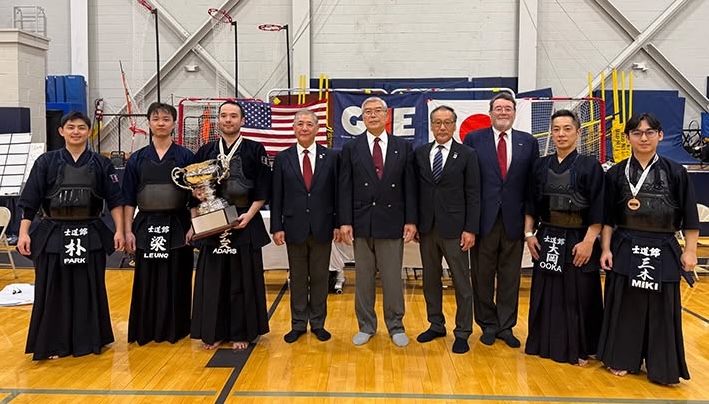
優勝選手と大会役員。中央背広姿左から石井猛・剣道8段範士・元警視庁師範、梯正治・剣道8段範士・元警視庁主席師範、加藤彰三・剣道8段教士・グレーター米国北東部剣道連盟会長(GNEUSKF) 志道学院NY士道舘館長、ルー・マーフィー GNEUSKF副会長兼大会会長
Tournament champions and officials. From left at center: Takeshi Ishii, Kendo Hanshi 8th Dan and former instructor of the Tokyo Metropolitan Police Department; Masaharu Kakehashi, Kendo Hanshi 8th Dan and former Chief Kendo Instructor of the Tokyo Metropolitan Police Department; Shozo Kato, Kendo Kyoshi 8th Dan, President of the Greater Northeast U.S. Kendo Federation (GNEUSKF) and Chief Instructor of Shidogakuin New York Shidokan; and Lewis Murphy, GNEUSKF Vice President and Tournament Chairman.
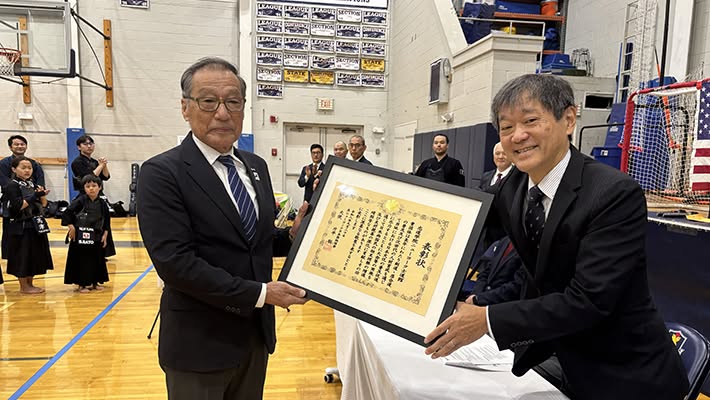
片平大使(右)から在外公館長表彰を受ける加藤館長
Shozo Kato-sensei receiving the Consul General’s Commendation from Ambassador Katahira.
From the Words Attributed to Oda Nobunaga
Reflections on the Kendo I Strive For
As I read through words and sayings commonly attributed to Oda Nobunaga, I am often struck by how closely many of their underlying ideas reflect what I have come to value through many years of practicing and teaching Kendo.
Not all of these sayings can be historically verified as Nobunaga’s own words. For me, however, their value lies not simply in who may have said them, but in what they can teach us when we reflect upon them through the practice of Kendo.
The following are my own interpretations—lessons that express the kind of Kendo I continue to seek.
“It also takes courage to step back.”
In Kendo, courage does not always mean moving forward.
There are times when we must resist the temptation to strike, adjust the distance, and begin our seme again.
But there is an important difference between stepping back and escaping.
The body may move backward, but the spirit must never retreat.
Even while creating distance, we maintain our connection with the opponent and prepare for the next opportunity.
That, too, is courage in Kendo.
“There are no absolutes.”
There is no point in Kendo at which we can say, “Now I have completed it.”
Something we were able to do yesterday may not work today. Something we could not understand when we were young may suddenly become clear after decades of training.
We should never allow our Kendo to become fixed.
We must continue questioning, changing, and learning.
The higher our rank becomes, the more willing we should be to return to the fundamentals.
“Be sensitive to the right moment.”
Of all these ideas, this is one that I consider especially important in Kendo.
Kendo is not simply a competition to see who can strike faster.
We apply pressure. We observe. We feel the opponent.
There is a moment when the opponent’s mind moves, when the kamae begins to break, when the opponent is about to strike, or when the opponent begins to retreat.
We must learn to recognize that moment—the ki, the opportunity.
Do not simply strike fast. Strike when the moment is right.
This is one of the ideals of Kendo that I continue to pursue.
“Have an ideal, and live by your convictions.”
We should have an ideal in our Kendo.
Winning alone should not be our purpose.
We should ask ourselves:
What kind of Kendo do I want to practice?
What kind of kendoka do I want to become?
We begin by learning from our teachers. Through mitori-geiko, we observe their Kendo and try to follow it.
But eventually, we must discover our own Kendo.
Do not merely imitate your teacher’s technique. Seek to understand the riai—the principles behind it.
To me, that is how a teacher’s Kendo is truly inherited.
“The greatest victory is to win without fighting.”
When we are young, we often try to win by striking faster.
As our Kendo develops, however, we begin to understand the importance of what happens before the strike.
Take the center. Apply pressure with the spirit. Create uncertainty. Cause the opponent to move.
By the time the opponent reacts, the decisive moment may already have been created.
My goal is to progress:
from striking in order to win,
to winning through seme and then striking.
And beyond that lies an even deeper ideal—the ability to control the encounter without needing to strike.
“Do not think it impossible. There is always a way.”
As we grow older, we cannot move exactly as we did when we were young.
But that should never become an excuse for our Kendo to stop developing.
When we lose speed, we can deepen our understanding of maai.
When physical strength diminishes, we can seek greater sae and riai.
When we can no longer rely on moving ourselves faster, we can learn how to move the opponent.
As the body changes, our Kendo should also change.
This is one reason Kendo can remain a lifelong pursuit.
“Everything begins and ends with preparation.”
An ippon is not created only at the instant the shinai reaches its target.
It comes from everything that has preceded it—daily kihon, proper appearance, reiho, care of our equipment, physical preparation, and our state of mind.
And when keiko ends, we reflect upon what happened.
That reflection becomes preparation for the next keiko.
Practice begins before we enter the dojo and continues after we leave it.
“One who has never known defeat may ultimately destroy himself.”
There is no shame in losing.
Defeat shows us what we still lack and what we still need to learn.
The greater danger comes when our rank becomes higher, people begin calling us “Sensei,” and we start believing that we already understand.
At that point, fewer people may correct us.
That makes self-reflection even more important.
When others no longer teach us, we must learn how to teach ourselves.
The higher our rank, the more humble we should become, and the more seriously we should remain students of Kendo.
“Follow your path. Do not be distracted by others.”
We do not need to compare our Kendo constantly with that of others.
Our bodies, ages, personalities, and experiences are different.
We should learn from our teachers, from our seniors, from our peers—and sometimes from our juniors and students.
But ultimately, each of us must walk our own path.
The goal is not simply to become better than someone else.
It is to become better than the person we were yesterday.
That continuous effort is shugyo.
“Work is something you must discover and create for yourself.”
The same is true of keiko.
We cannot improve simply by waiting for a teacher to tell us what to do.
We should constantly ask ourselves:
What can I learn today?
Why was I struck?
Why did my technique fail?
What can I learn from this opponent?
A serious student learns to discover his or her own problems.
Good keiko is not something a teacher simply gives us. We must also learn to create it ourselves.
“Do it or do not do it. That is all.”
In Kendo, if we wait until the opportunity appears and then begin thinking about whether to strike, the opportunity is already gone.
We apply seme.
The opponent breaks.
The moment comes.
Then there can be no hesitation.
Be patient and deliberate in creating the opportunity.
When the moment comes, commit completely.
This is what I understand by Sutemi does not mean attacking recklessly. It means that after sufficient seme and after recognizing the true opportunity, we abandon hesitation and give ourselves completely to the strike.
“Only by living wholeheartedly does one’s life truly shine.”
When we are young, we may pursue victory.
Later, we may pursue rank.
But if we continue practicing for many years, the meaning of Kendo gradually changes.
There is a time when we practice primarily for ourselves.
Then comes a time when we have a responsibility to teach and develop others.
And perhaps eventually, there comes a time when younger generations can learn something simply by watching how we practice, how we conduct ourselves, and how we continue our own shugyo.
Kendo is not only about taking ippon.
It is also about how we train, how we face others, how we face ourselves, and ultimately how we live.
That, to me, is Kendo.
A Lifelong Mitori-Geiko
I do not believe there is a final point of completion in Kendo.
When we are young, we learn through our bodies.
With experience, we begin to understand riai.
When we become instructors, we discover that we can learn from the very people we teach.
We learn by watching our teachers.
We learn from our fellow kendoka.
We learn from our students.
And we learn from the person we ourselves were yesterday.
Rank does not change the fact that we remain students of the Way.
Teaching does not end our own shugyo.
The teacher is also a student.
And perhaps this is one of the most important lessons Kendo has given me:
Kendo is a lifelong practice of 見取り稽古 — mitori-geiko.
Past Events
36th Greater Northeast U.S. Kendo Tournament
We are pleased to announce that the GNEUSKF will be hosting the 36th Greater Northeast U.S. Kendo Tournament on Sunday, September 20th, at the Keio Academy of New York Gymnasium, in collaboration with Shidogakuin New York Shidokan.
In conjunction with this event, we will hold a seminar and joint practice session on the evening of Friday, September 18, at the New York Shidokan in Pleasantville, followed by a seminar at the same dojo on Saturday, September 19.
For this tournament and seminar, we are honored to have Masaharu Kakehashi sensei (Hanshi, 8th Dan), former Chief Shihan of the Tokyo Metropolitan Police Department and Shihan at Nogi Shrine Shobukan and Takeshi Ishii (Hanshi, 8th Dan), former Shihan of the Tokyo Metropolitan Police Department and Shihan at the Tokyo Budokan.
We understand you are all very busy, but we look forward to your participation.
Shozo Kato, President of GNEUSKF and Shihan of Shidogakuin NY Shidokan
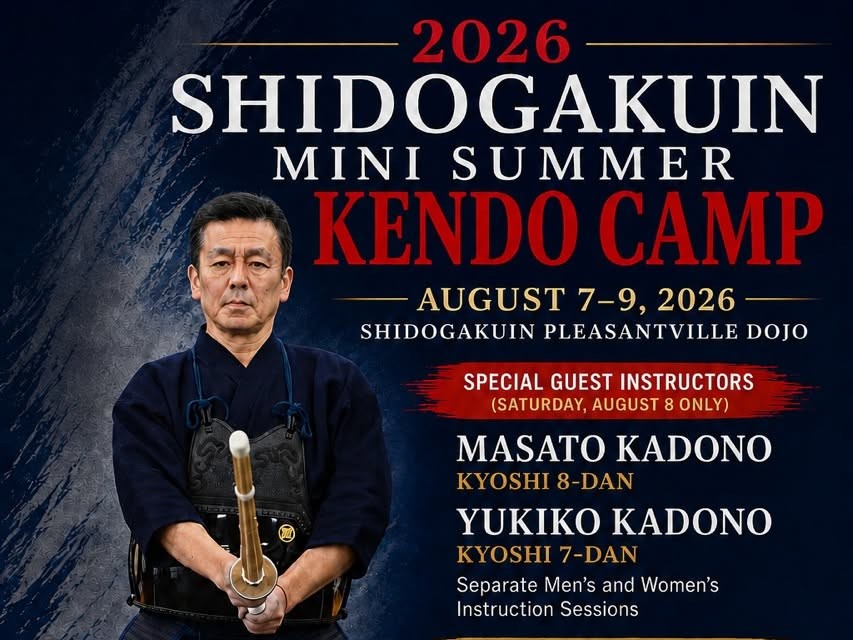
2026 Shidogakuin Mini Summer Kendo Camp
Dear Kendo Friends and Young Kendoka,
Shidogakuin NY Shidokan is pleased to announce our annual Mini Summer Kendo Camp, which will be held from August 7–9, 2026.
This year, we are honored to welcome special guest instructors who previously visited us eight years ago: Mr. Masato Kadono sensei (門野政人先生), Kyoshi 8-Dan, and Mrs. Yukiko Kadono sensei (門野由紀子先生), Kyoshi 7-Dan. On Saturday, August 8, they will conduct separate seminars for men's and women's instruction sessions.
Camp Director & Chief Instructor: Shozo Kato, Kyoshi 8-Dan, Shidogakuin NY Shidokan. All camp sessions, except the special guest seminars on August 8, will be led by Shozo Kato Sensei.
Event Highlights:
- Intensive Kendo Training
- Kendo Kata
- Youth Kendo Tournament
- Adult Kendo Tournament
- GNEUSKF Kyu & Dan Examination
Registration Deadline: July 26, 2026. Registration link coming soon!
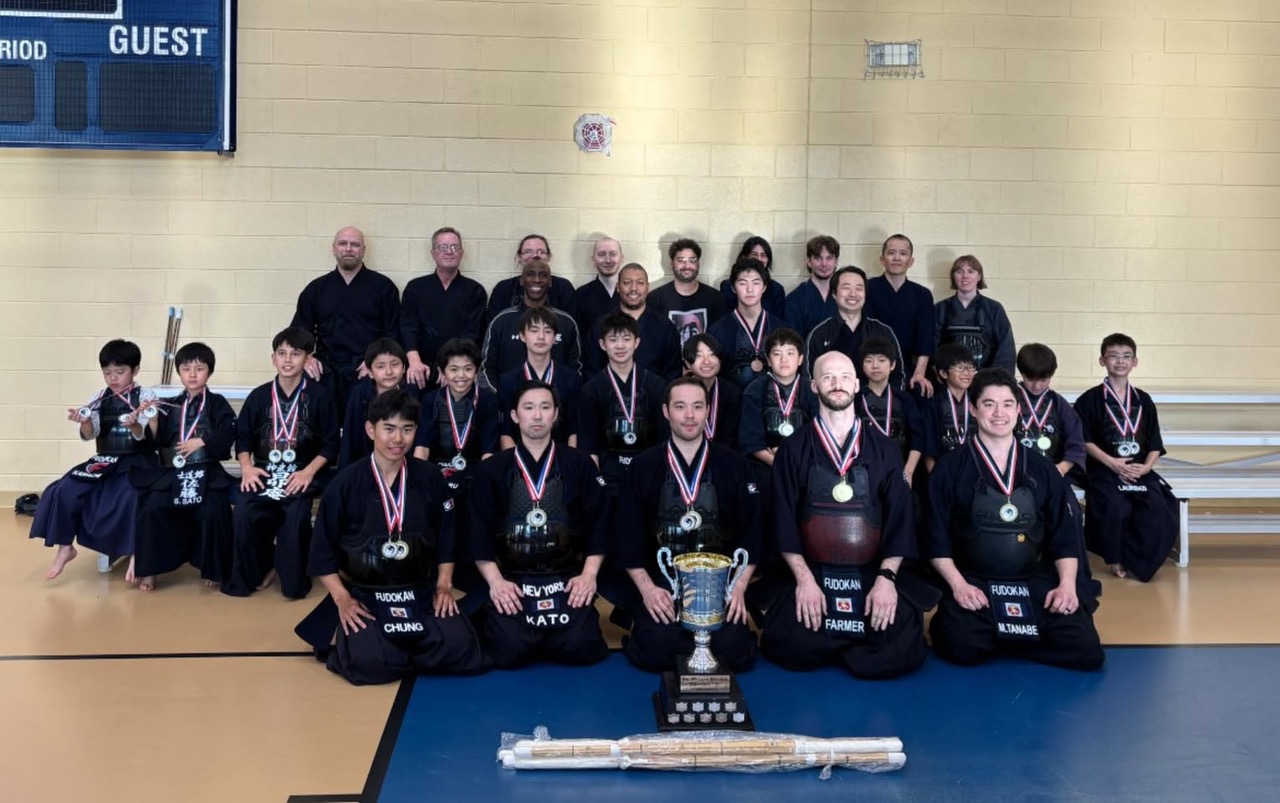
Baltimore Kendo Tournament
The Baltimore Kendo Tournament held June 6–7, 2026, at the Pip Moyer Recreation Center at Truxtun Park, the GNE team won numerous awards, including first, second, and third place in the men's team and individual events, as well as the Youth Team Championship, the Youth Individual Championship, and other top finishes.
This was their last tournament before the 2026 U.S. National Kendo Championships, to be held on Independence Day in July, and their strong performance across all categories sets them up well for the upcoming competition.
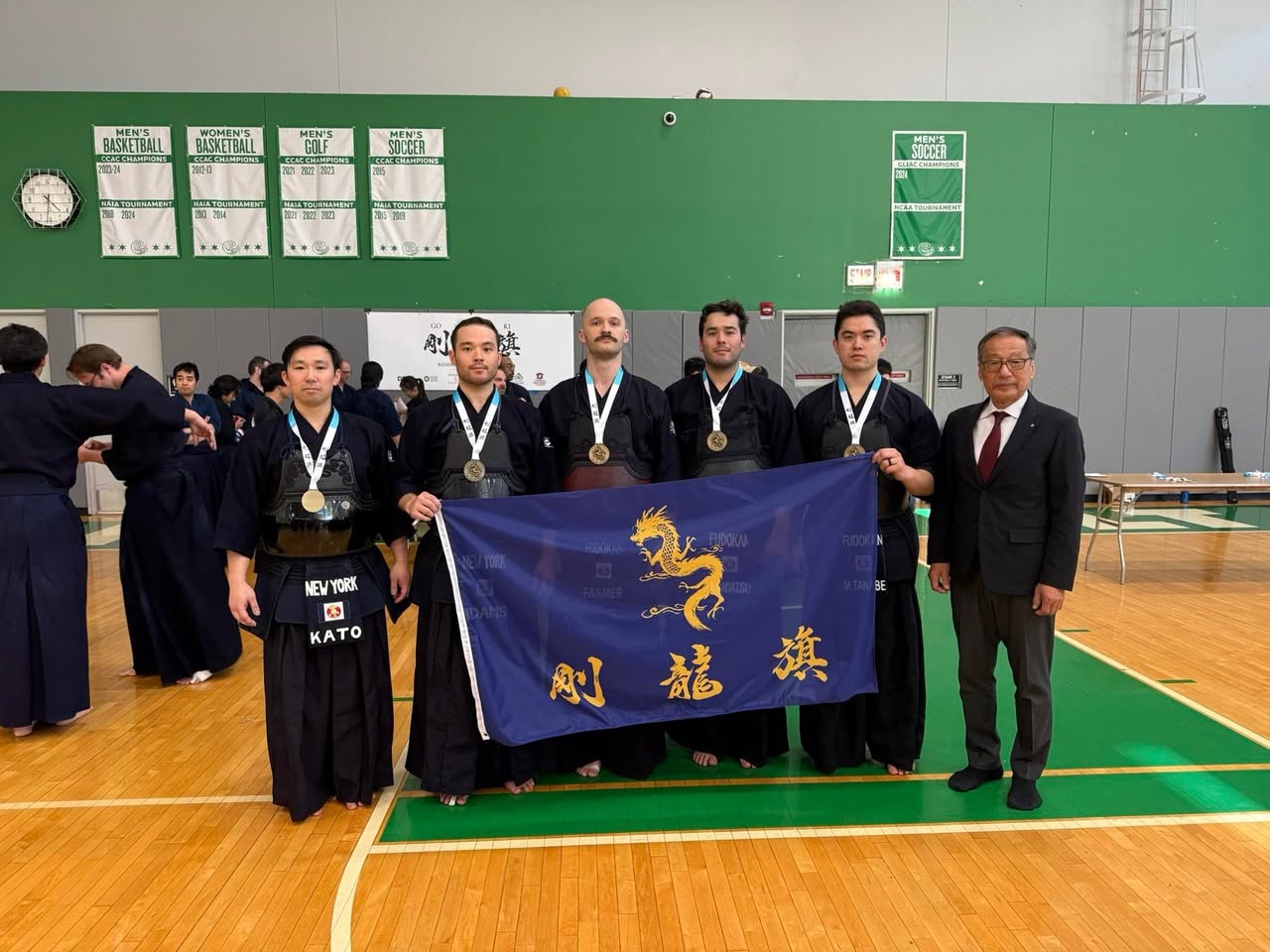
5th Anniversary Tournament (GO-RYU-KI) of the Goseikan Dojo
On May 24, 2026, the 5th Anniversary Tournament (GO-RYU-KI) of the Goseikan Dojo (led by Director Gordon Small sensei) was held in Wabash, Chicago.
The tournament featured team matches between regional federation teams and dojo teams.
The GNE team secured a hard-fought victory over the Midwest B team in the semifinals and, after a thrilling match against the powerhouse Midwest A team in the finals, managed to pull off a lucky win to claim the championship.
Although this was the dojo's first time organizing the tournament, the event ran smoothly and was exceptionally well-managed.
We would like to express our heartfelt gratitude to the event staff, volunteers, and referees.
We look forward to seeing everyone again at this tournament next year.

The 35th Greater Northern United States Kendo Tournament Held in Purchase
~130 Participants, 17 Dojos Gathered~
On Sunday, September 21, 2025, the 35th Greater Northern United States Kendo Tournament was held at Keio Academy New York in Purchase, New York. Hosted by: Shidogakuin NY Shidokan.
Approximately 130 participants, ranging from children under 9 years old to adults in their 70s, took part in this tournament. Representatives from 17 dojos gathered for a grand event featuring individual matches divided by age group and gender, as well as team matches representing each dojo.
In his closing remarks, Chief Referee Masaharu Kakehahsi Hanshi (Hanshi 8th Dan, former Chief Kendo Instructor of the Metropolitan Police Department) praised all participants for their efforts. He then shared a long-held teaching: “In kendo matches, it is better to be a beautiful loser than an unsightly winner.” He further advised, “Rather than becoming fixated on winning through shiai where fundamentals break down due to forgetting etiquette while obsessing over victory or defeat, aiming for correct kendo that prioritizes fundamentals will ultimately lead to becoming a truly great victor in the future.”
第35回グレーター米国北部剣道大会、Purchaseで開催
〜130名が参加、17道場が集結〜
2025年9月21日(日)、ニューヨーク州Purchaseにある慶應義塾ニューヨーク学院にて、第35回グレーター米国北部剣道大会が開催された。主催:志道学院NY士道館。
本大会には、9歳以下の子供から70歳台の大人まで、約130名が参加。17の道場が集まり、年代別・男女別の個人戦、道場別の団体戦が盛大に行われた
最後の講評として、梯正治審判長(範士8段元警視庁剣道主席師範)からは、各参加者への健闘を称えた上で、昔からの教えで、「剣道の試合では見苦しい勝者になるより、美し敗者であれ」「勝敗に拘ることで礼儀を忘れた基本の崩れた試合で勝つことにだけ執着するにではなく、基本を重視した正しい剣道を目指すことが結局は将来の大きな素晴らしい勝者となることに繋がる」の教えの言葉をいただいた。
Individuals
9 years and under
1st Place
Sean Byun (Fudokan)
2nd Place
Keizo Oda (Kenshinkai)
3rd Place
Keiju Yamanaka (Fudokan)
10-12 Years old
1st Place
Shin Ootsuru (Fudokan)
2nd Place
Luan Rrustemi (Shinbukan)
3rd Place
Kazunari Manabe (Shidokan)
13-15 years old
1st Place
Haruma Date (Kenshinkai)
2nd Place
Haruhito Takatsu (Shidokan)
3rd Place
Dylan Condon (Kenshinkai)
Girl’s Division (13-18 years old)
1st Place
Sumire Ochiai (Kenshinkai)
2nd Place
Emily Miyabi Yozai (Kenshinkai)
3rd Place
Yumie Takeda (Shidokan)
High School Division (16-18 years old)
1st Place
So Ootsuru (Fudokan)
2nd Place
Caleb Model (Shidokan)
3rd Place
Collin Lu (Cherry Hill Kenyukai)
1 Dan and Below
1st Place
Suho Lee (Chung Pa Kendo Dojo)
2nd Place
Hoyoung Jin (Rutgers University)
3rd Place
Teahyuun Kim (KSK)
2-4 Dan Dvision
1st Place
Hojun Yoo (Garden State Kendo)
2nd Place
Kei Takahashi (Garden State Kendo)
3rd Place
Joshua Yang (Cherry Hill Kenyukai)
5 Dan and Above
1st Place
Dunkin Adams (Shidokan) Nittsu Hai
2nd Place
Taishi Kato (Shidokan)
3rd Place
Nigel Alcorn (Kenshinkai)
Women’s Division
1st Place
Arum Seo (NYC)
2nd Place
Kazusa Tokutsu (Choyokan Kendo Dojo)
3rd Place
Amber Tsai (Garden State Kendo)
Senior Division
1st Place
Kenichi Hatakeyama (Waco Kendo Dojo)
2nd Place
Shinichiro Fukui (Kenshinkai)
3rd Place
Michael Manning (Shidokan)
Teams
Youth Team
1st Place
Fudokan
2nd Place
Mixed Team
3rd Place
Kenshinkai A
Girl’s Team
1st Place
Chung Pa Kendo Dojo
2nd Place
Mixed Team
3rd Place
Keio Academy
High School Team
1st Place
Fudokan Mitsukoshi Cup
2nd Place
Shidokan
3rd Place
Keio Academy
Senior Team
1st Place
Shidokan B
2nd Place
Mixed Team
3rd Place
Shidokan A
Adult Team
1st Place
Garden State Kendo Hanshi Imai Saburou Cup
2nd Place
Shidokan
3rd Place
Cherry Hill Kenyukai
Shidogakuin Summer Camp 2025
We are pleased to announce the 2025 Shidogakuin Summer Camp.
Location: New York Shidokan Pleasantville Dojo
Date: Friday, August 8th, afternoon ~ Sunday, August 10th.
GNE Kendo Examination (up to 4 dan): Sunday August 10th, 1:00 PM
We will provide further details regarding the schedule at a later date. Please save the dates and we look forward to seeing many kendo practitioners participate.
Newsletter Edition #1: On Bushido
Click here to read the full newsletter
This time, I would like to consider Bushido as a way of thinking.
This is a very difficult concept to understand, but five years before the death of my late teacher, the late Yasushi Nakanishi (30th anniversary of death this year), he came to the Shidokan 10th anniversary tournament at the Shidogakuin NY Shidokan in New York, and said to me:
“Kato-kun, spread kendo and iaido and make the town clean.”
I was so confused that I didn't understand what he was talking about, just standing there looking blank...
"Who is going to clean up all the trash that's scattered around the town? If everyone picks up one piece of trash and puts it in the trash, the town will become clean. Instead of blaming the person who threw it away, if you pick up one piece of trash, 100 people will pick up 100 pieces of trash, and 1000 people will pick up 1000 pieces of trash."
Furthermore, he gave me a very big goal: 'If you spread the morals of Bushido through Kendo and Iaido, the town will become clean.
I am still in the middle of my training, but I hope to consider and better understand Bushido together with everyone.
2025 Kagamibiraki Tournament
NY Shidokan is pleased to announce the 2nd New Year (Kagamibiraki) tournament will be held on Sunday, January 19th. Kagamibiraki is a traditional Japanese event in which the Kagamimochi that were displayed during the New Year are taken down from the alcove or alcove of a Shinto altar and eaten to pray for good health and good fortune. The "kagami" in kagamimochi and kagami-biraki means peace and happiness, and the "biraki" means the end of the year.
We are please to announce the attendance of Noriyasu Gonpei-sensei (a Shihan at the Tokyo Metropolitan Police Department) as head judge for this event. There will be a kendo seminar after the match by Gonpei-sensei.
Location: Keio Academy of New York (GYM)
Address : 3 College Rd Purchase, NY 10577
Schedule and Division: Sunday, January 19th, 2025
Registration Start 8:15 a.m.
9:00 a.m. Opening ceremony
Awards ceremony and closing ceremony will be held after the tournament and the ending time is scheduled at 3:00 pm.
Downtown Dojo New Location
Starting Thursday, October 3rd, our downtown dojo location will be moving to the following venue:
184 Eldgride Street 6F, New York NY 10002
In order to accommodate parking, Thursday practice will also being 30 minutes later: 7:30pm - 9:30pm.
Downtown Location Opening
NY Shidokan is pleased to announce that starting April 4th, we will
begin regular practice on Thursdays at a new downtown location:
273 Bowery, New York, NY 10002
NY Shidokan Kagamibiraki Tournament
NY Shidokan is pleased to announce the New Year (Kagamibiraki) tournament for all of you. Kagamibiraki is a traditional Japanese event in which the Kagamimochi that were displayed
during the New Year are taken down from the alcove of a Shinto altar and eaten to
pray for good health and good fortune.
Our celebratory Shiai will include individual youth divisions as well as a team competition for adults.
To register for the event, please use this form and see our annoucment flyer for more details.

40th Anniversary Celebration
In honor of the 40th anniversary of our dojo, we will be holding a celebration event on Saturday, June 3rd and Sunday, June 4th 2023 at the NY Shidokan Pleasantville Dojo.
We are pleased to announce our special guest of honor will be Masaharu Kakehashi-sensei. Please mark your calendars.
The term "Shin-Gi Ichinyo” means:
The word "Shin" refers to the mental spirit, and "Gi" refers to the skill.
The word "Ichinyo" means one and the same thing that cannot be divided.
This word has been used in martial arts such as kendo since ancient times and
it means that daily training to improve one's technique will cultivate one's mind
and enhance one's character.
The fighting spirit of a fighter who faces his opponent fairly and squarely and gives it his
all in a match or Tachiai will people's hearts and impresses them.

New Midtown Dojo Location Open!
Our Midtown dojo will be offering Iaido classes after Thursday Kendo practice starting in August.
In the space of this wonderful dojo, you can unify your mind and practice Iaido (a traditional Japanese martial art performed with sword and with a 450-year-old history) to improve both body and mind.” Shihan Shozo Kato
617 W 46th Street, 6th Floor, New York NY 10036
- Thursday
- 6:30pm - 7:30pm Basics Class
- 7:30pm - 8:30pm Advanced Class
- 8:30pm - 9:30pm Iaido (All levels) or Kendo no kata (Advanced)
- Sunday
- 9:15am - 10:00am Kendo Youth and Beginner Class
- 10:00am - 10:30am Bogu Basic and Beginner Uchikomi Class
- 10:30am - 11:30am Kendo Jigeiko
Requirement for participation: must be a member of AUSKF
New Location for Manhattan Shidokan
On Sunday, June 6th, our Manhattan location will open for practice on Sundays with the following schedule
Church Street Boxing Gym 25 Park Pl, NY 10007
- Sunday
- 9:00am - 9:45am Kendo Youth and Basics class
- 9:45am - 10:15am Kendo Youth and Adult Bogu class
- 10:15am - 11:00am Kendo Advanced
Requirement for participation: must be a member of AUSKF
Updated schedule for NY Shidokan
175 Tompkins Avenue, Pleasantville, NY 10570 [Directions]
- Tuesday
- 5:45pm Dojo open
- 6:00pm - 7:00pm Kendo Youth and Basics class
- 7:00pm - 7:30pm Kendo Youth and Adult Bogu class
- 7:30pm - 8:15pm Kendo Advanced
- 8:15pm Dojo Cleanup
- Saturday
- 12:45pm Dojo open
- 1:00pm - 3:40pm Iaido all levels
- 4:00pm - 5:00pm Kendo Youth and Beginner class
- 5:00pm - 5:30pm Kendo Youth and Adult Bogu basic class
- 5:30pm - 6:30pm Kendo Advanced class
- 6:30pm Dojo clean up
- Sunday
- 1:45pm Dojo set-up
- 2:00pm - 4:20pm Iaido class all levels
- 4:30pm - 5:15pm Kendo Youth and Beginner class
- 5:15pm - 5:45pm Kendo Youth and Adult Bogu basic class
- 5:45pm - 6:30pm Kendo Advanced Class
- 6:30pm Dojo clean up
Practice in the last weekend (Saturday and Sunday) will be off as there will be table-tennis
event every month. Please also note that we will conduct Kendo and Iaido practice in the
last Sunday of the month in Fort Lee, NJ once we resume bogu practice
Requirement for participation: must be a member of AUSKF
March Practice Suspended
Due to the effects of the corona virus, practice for the remainder of March has been cancelled.
Please see below for our April schedule when practice at our New York location resumes on April 5th.
27th Shidogakuin Kendo Tournament: Postponement announcement
The tournament is postponed due to various unforeseen circumstances. We will be announcing a new official date soon, likely in May.
New NY Location and Schedule
Please note that we have relocated our practice for the New York dojo.
Our new location is at: 37 W 26th Street, 9th Floor, New York, NY
Our adjusted schedule for April is as follows:
- Sunday, April 5th
- 11:00 am - 1:00 pm Kendo: Studio D
- 1:00 - 3:00 PM Iaido: Studio A
- Thursday, April 9th
- 7:30pm - 8:30pm Kendo Basics: Studio A
- 8:30pm - 10:00pm Kendo Advanced: Studio D
- Sunday, April 12th
- 11:00 am - 1:00 pm Kendo: Studio D
- 1:00 - 3:00 PM Iaido: Studio A
- Thursday, April 16th
- 7:30pm - 8:30pm Kendo Basics: Studio A
- 8:30pm - 10:00pm Kendo Advanced: Studio D
- Sunday, April 19th
- 11:00 am - 1:00 pm Kendo: Studio D
- 1:00 - 3:00 PM Iaido: Studio A
- Thursday, April 23rd
- 7:30pm - 8:30pm Kendo Basics: Studio A
- 8:30pm - 10:00pm Kendo Advanced: Studio D
- Sunday, April 26th
- 1:00 - 3:00 PM Iaido: Studio A
- Thursday, April 30th
- 7:30pm - 8:30pm Kendo Basics: Studio A
- 8:30pm - 10:00pm Kendo Advanced: Studio D

GNE Kendo Educational Seminar: Harrison NY date
Dear Senseis, Kenshis and Parents,
We would like to invite AUSKF members to particpate in a set of educational seminars conducted by:
- Masaharu Kakehashi-sensei, Hanshi 8th Dan: Tokyo Japan, former Chief Instructor of Kendo at Tokyo Metropolitan Police
- Koji Onda-sensei, Kyoshi 8th Dan: Tokyo Japan, Assistant Instructor of Kendo at Tokyo Metropolitan Police
- Shozo Kato-sensei, Kyoshi 8th Dan
The seminar will be held 4:00pm - 7:00pm at Harrison Recreation Center, 270 Harrison Ave, Harrison NY 10528
A Dinner party for adult participants will follow at 7:30 at a location to be determined. Advance reservation of your spot will be necessary.
Please complete and return these forms (instructions within) to register

GNE Kendo Educational Seminar: Fudokan Washington DC date
Dear Senseis, Kenshis and Parents,
We would like to invite AUSKF members to particpate in a set of educational seminars conducted by:
- Masaharu Kakehashi-sensei, Hanshi 8th Dan: Tokyo Japan, former Chief Instructor of Kendo at Tokyo Metropolitan Police
- Koji Onda-sensei, Kyoshi 8th Dan: Tokyo Japan, Assistant Instructor of Kendo at Tokyo Metropolitan Police
- Shozo Kato-sensei, Kyoshi 8th Dan
The seminar will be held 6:00pm - 9:00pm at Fudokan Dojo, 5100 Edgemoor Ln, Bethesda, MD 20814
GNE Kendo Educational Seminar: Miami Dates
Dear Senseis, Kenshis and Parents,
We would like to invite AUSKF members to particpate in a set of educational seminars conducted by:
- Masaharu Kakehashi-sensei, Hanshi 8th Dan: Tokyo Japan, former Chief Instructor of Kendo at Tokyo Metropolitan Police
- Koji Onda-sensei, Kyoshi 8th Dan: Tokyo Japan, Assistant Instructor of Kendo at Tokyo Metropolitan Police
- Shozo Kato-sensei, Kyoshi 8th Dan
The seminars for both nights will be at Stone Mountain Taekwondo Academy, 10024 W Oakland Park Blvd, Sunrise, FL 33351 and will begin at 7:00 p.m. and end at 9:30 p.m.

2019 Shidogakuin Kendo Camp and 35th Anniversary Tournament
The 35th Shidogakuin Anniversary Open Tournament was be held on Saturday the 3rd. We'd like to thank everyone who participated and the sensei and shinpan for their support!
Ages 12 and under (kihon competition)
1st Place
Ryotaro Okano, Shidogakuin Harrison
2nd Place
Caleb Model, Shidogakuin NY
3rd Place
Kota Mizobuchi, Shidogakuin Harrison
3rd Place
Luka Ito, Shidogakuin Harrison
Ages 13-18
1st Place
Shuta Iwai, Shidogakuin Harrison
2nd Place
Towa Machida, Shidogakuin Harrison
3rd Place
Brendon Hwang, Washinkan
Mudansha Kachinuki
1st Place
Shidogakuin Harrison / Fudokan
2nd place
Mixed Team (Houston / Fudokan / Shidogakuin NY)
3rd Place
Fudokan
Outstanding Player
David Christopher, Shidogakuin Harrison
Women's Kachinuki
1st Place
Washinkan
2nd Place
Boston Shufukai
3rd Place
Fudokan
Outstanding Player
Yasuko Mohler, Washinkan
Men's Yudansha Kachinuki
1st Place
Shidogakuin A
2nd Place
SEUSKF A
3rd Place
Fudokan
Outstanding Player
James Ro (SEUSKF A)
Outstanding Player
Alistair Faghani (Fudokan)
Outstanding Player
Shuta Iwai (Shidogakuin A)
Best Player
Kotaro Yoshida (Washinkan / Univ. of Chicago)
Kendo Seminar with Ishii-sensei
Greetings! We are happy to share with you that Takeshi Ishii Sensei, Kendo Kyoshi 8 Dan, Former Tokyo Metropolitan Police (Keishicho), Vice Syuseki Shihan and Nippon Budokan Kendo Dojo Shihan, will visit be visiting New York.
To attend: Please email name, rank and dojo to info@shidogakuin.com
Ishii Sensei is the featured Sensei for 2019 GNEUSKF Kendo Education Tour. He will give seminars on Saturday, March 23 and Sunday, March 24. Please see below information:
Date:
Saturday, March 23rd
Time:
5:00pm - 8:00pm
(Doors open at 4:30 PM)
Location:
Shidogakuin Harrison Dojo, Harrison Rec. Center (aka Frank Sollazzo Center), 270 Harrison, Avenue, Harrison, NY
Level:
All ages, all levels
Contribution
Ages 17 and under: $10
Ages 18 and over: $20
Date:
Sunday, March 24th
Time:
3:00pm - 6:30pm
(Doors open at 2:45 PM)
Location:
Shidogakuin New York Dojo, 265 Madison Avenue, NY, NY
Level:
Yudansha (shodan and up)
Contribution
$20

Rutger's University Kendo Seminar
On Saturday March 2, GNEUSKF(President Tsuyoshi Inoshita .Kendo kyoshi 7 dan) and Shidogakuin(Chairman of Shozo Kato. Kendo kyosh 8dan) sponsored Kendo seminar at Rutgers University Kendo club. 60 people participated from the age of 6 to upper 70 years old, and started with a lecture of "What is the significance,goal, purpose of kendo", then guidance on basic striking with Bogu, and the second half of the seminar in the Shinsa and competition of the Kendo, guidance such as the Waza evaluated by the judge was carried out. Lastly it was a lively seminar with the last 40 minutes of joint practice.

26th Annual Shidogakuin Tournament
On Sunday March 3rd, the 26th Shidogakuin Rutgers Kendo Tournament (Youth,High School, University and General) was attended by about 200 participants and started with a big spirit(Ki-ai) of children and it was held grandly.
A Division (Ages up to 10)
1st Place
Ken Uemoto, NY Kenshinkai
2nd Place
Joseph Kwak, Cherry Hill Kenyukai
3rd Place
Caleb Model, Shidogakuin NY
3rd Place
Luka Ito, Shidogakuin Harrison
Fighting Spirit
Lynn Uemoto, NY Kenshinkai
G Division (4 dan and up Adult)
1st Place
Ryoma Tominaga, Shidogakuin NY
2nd Place
Taishi Kato, Shidogakuin NY
3rd Place
Dunkin Adams, Shidogakuin NY
3rd Place
Sunghun Choi, GSK
Fighting Spirit
Sungha Park, Columbia University
B Division (Ages 11 - 12)
1st Place
Rachel Yoon, GSK
2nd Place
Kenneth Ryu, Ridgefield Kendo Club
3rd Place
Sean Lee, GSK
3rd Place
Joshua Hong, GSK
Fighting Spirit
Samuel Kim, Ridgefield Kendo Club
Women (Ages 16+)
1st Place
Sachiho Jinnaka, Keio Academy of NY
2nd Place
Hanna Kim, GSK
3rd Place
Alissa Mori, Columbia University
3rd Place
Jessica Ye, Yale University
Fighting Spirit
Kaeda Kurosaki, Keio Academy of NY
C Division (Ages 13 - 15)
1st Place
Brendon Hwang, Washinkan
2nd Place
Hinako Yokohagi, NY Kenshinkai
3rd Place
James Kwak Jr., Cherry Hill Kenyukai
3rd Place
Daniel Mori, NY Kenshinkai
Fighting Spirit
Yoichi Watanabe, Shufukai
D Division (Ages 16 - 18)
1st Place
Sachiho Jinnaka, Keio Academy of NY
2nd Place
Kaeda Kurosaki, Keio Academy of NY
3rd Place
Yujin Kim, Washinkan
3rd Place
Yurin Kim, Washinkan
Fighting Spirit
David Darlington, Shidogakuin NY
E Division (Ages 13 - 15)
1st Place
Jae Shin, Fudokan
2nd Place
Matthew Adeniji, Stony Brook University
3rd Place
Siddarth Govindan, Shidogakuin NY
3rd Place
Dan Folescu, Virgina Tech Kendo Club
Fighting Spirit
Kyle Wang, Cornell University
F Division (1 dan to 3 dan)
1st Place
Vincent Choi, NYU
2nd Place
Thomas Koizumi, West Point
3rd Place
Joseph Wong, Rutgers Kendo Club
3rd Place
Alex Zhang, Shidogakuin NJ
Fighting Spirit
Jonathan Kim, Rutger's Kendo Club
Youth Team
1st Place
GSK B
2nd Place
Shidogakuin Harrison
3rd Place
Cherry Hill Kenyukai
3rd Place
GSK A
Mitsukoshi Cup
1st Place
NYU A
2nd Place
Keio Academy of NY A
3rd Place
Cornell University A
3rd Place
West Point A
Kato Cup
Sachiho Jinnaka, Keio Academy of NY
36th Greater Northeast U.S. Kendo Tournament
We are pleased to announce that the GNEUSKF will be hosting the 36th Greater Northeast U.S. Kendo Tournament on Sunday, September 20th, at the Keio Academy of New York Gymnasium, in collaboration with Shidogakuin New York Shidokan.
In conjunction with this event, we will hold a seminar and joint practice session on the evening of Friday, September 18, at the New York Shidokan in Pleasantville, followed by a seminar at the same dojo on Saturday, September 19.
For this tournament and seminar, we are honored to have Masaharu Kakehashi sensei (Hanshi, 8th Dan), former Chief Shihan of the Tokyo Metropolitan Police Department and Shihan at Nogi Shrine Shobukan and Takeshi Ishii (Hanshi, 8th Dan), former Shihan of the Tokyo Metropolitan Police Department and Shihan at the Tokyo Budokan.
We understand you are all very busy, but we look forward to your participation.
Shozo Kato, President of GNEUSKF and Shihan of Shidogakuin NY Shidokan
2026 Shidogakuin Mini Summer Kendo Camp
Dear Kendo Friends and Young Kendoka,
Shidogakuin NY Shidokan is pleased to announce our annual Mini Summer Kendo Camp, which will be held from August 7–9, 2026.
This year, we are honored to welcome special guest instructors who previously visited us eight years ago: Mr. Masato Kadono sensei (門野政人先生), Kyoshi 8-Dan, and Mrs. Yukiko Kadono sensei (門野由紀子先生), Kyoshi 7-Dan. On Saturday, August 8, they will conduct separate seminars for men's and women's instruction sessions.
Camp Director & Chief Instructor: Shozo Kato, Kyoshi 8-Dan, Shidogakuin NY Shidokan. All camp sessions, except the special guest seminars on August 8, will be led by Shozo Kato Sensei.
Event Highlights:
- Intensive Kendo Training
- Kendo Kata
- Youth Kendo Tournament
- Adult Kendo Tournament
- GNEUSKF Kyu & Dan Examination
Registration Deadline: July 26, 2026. Registration link coming soon!
Baltimore Kendo Tournament
The Baltimore Kendo Tournament held June 6–7, 2026, at the Pip Moyer Recreation Center at Truxtun Park, the GNE team won numerous awards, including first, second, and third place in the men's team and individual events, as well as the Youth Team Championship, the Youth Individual Championship, and other top finishes.
This was their last tournament before the 2026 U.S. National Kendo Championships, to be held on Independence Day in July, and their strong performance across all categories sets them up well for the upcoming competition.
5th Anniversary Tournament (GO-RYU-KI) of the Goseikan Dojo
On May 24, 2026, the 5th Anniversary Tournament (GO-RYU-KI) of the Goseikan Dojo (led by Director Gordon Small sensei) was held in Wabash, Chicago.
The tournament featured team matches between regional federation teams and dojo teams.
The GNE team secured a hard-fought victory over the Midwest B team in the semifinals and, after a thrilling match against the powerhouse Midwest A team in the finals, managed to pull off a lucky win to claim the championship.
Although this was the dojo's first time organizing the tournament, the event ran smoothly and was exceptionally well-managed.
We would like to express our heartfelt gratitude to the event staff, volunteers, and referees.
We look forward to seeing everyone again at this tournament next year.
The 35th Greater Northern United States Kendo Tournament Held in Purchase
~130 Participants, 17 Dojos Gathered~
On Sunday, September 21, 2025, the 35th Greater Northern United States Kendo Tournament was held at Keio Academy New York in Purchase, New York. Hosted by: Shidogakuin NY Shidokan.
Approximately 130 participants, ranging from children under 9 years old to adults in their 70s, took part in this tournament. Representatives from 17 dojos gathered for a grand event featuring individual matches divided by age group and gender, as well as team matches representing each dojo.
In his closing remarks, Chief Referee Masaharu Kakehahsi Hanshi (Hanshi 8th Dan, former Chief Kendo Instructor of the Metropolitan Police Department) praised all participants for their efforts. He then shared a long-held teaching: “In kendo matches, it is better to be a beautiful loser than an unsightly winner.” He further advised, “Rather than becoming fixated on winning through shiai where fundamentals break down due to forgetting etiquette while obsessing over victory or defeat, aiming for correct kendo that prioritizes fundamentals will ultimately lead to becoming a truly great victor in the future.”
第35回グレーター米国北部剣道大会、Purchaseで開催
〜130名が参加、17道場が集結〜
2025年9月21日(日)、ニューヨーク州Purchaseにある慶應義塾ニューヨーク学院にて、第35回グレーター米国北部剣道大会が開催された。主催:志道学院NY士道館。
本大会には、9歳以下の子供から70歳台の大人まで、約130名が参加。17の道場が集まり、年代別・男女別の個人戦、道場別の団体戦が盛大に行われた
最後の講評として、梯正治審判長(範士8段元警視庁剣道主席師範)からは、各参加者への健闘を称えた上で、昔からの教えで、「剣道の試合では見苦しい勝者になるより、美し敗者であれ」「勝敗に拘ることで礼儀を忘れた基本の崩れた試合で勝つことにだけ執着するにではなく、基本を重視した正しい剣道を目指すことが結局は将来の大きな素晴らしい勝者となることに繋がる」の教えの言葉をいただいた。
Individuals
9 years and under
| 1st Place | Sean Byun (Fudokan) |
| 2nd Place | Keizo Oda (Kenshinkai) |
| 3rd Place | Keiju Yamanaka (Fudokan) |
10-12 Years old
| 1st Place | Shin Ootsuru (Fudokan) |
| 2nd Place | Luan Rrustemi (Shinbukan) |
| 3rd Place | Kazunari Manabe (Shidokan) |
13-15 years old
| 1st Place | Haruma Date (Kenshinkai) |
| 2nd Place | Haruhito Takatsu (Shidokan) |
| 3rd Place | Dylan Condon (Kenshinkai) |
Girl’s Division (13-18 years old)
| 1st Place | Sumire Ochiai (Kenshinkai) |
| 2nd Place | Emily Miyabi Yozai (Kenshinkai) |
| 3rd Place | Yumie Takeda (Shidokan) |
High School Division (16-18 years old)
| 1st Place | So Ootsuru (Fudokan) |
| 2nd Place | Caleb Model (Shidokan) |
| 3rd Place | Collin Lu (Cherry Hill Kenyukai) |
1 Dan and Below
| 1st Place | Suho Lee (Chung Pa Kendo Dojo) |
| 2nd Place | Hoyoung Jin (Rutgers University) |
| 3rd Place | Teahyuun Kim (KSK) |
2-4 Dan Dvision
| 1st Place | Hojun Yoo (Garden State Kendo) |
| 2nd Place | Kei Takahashi (Garden State Kendo) |
| 3rd Place | Joshua Yang (Cherry Hill Kenyukai) |
5 Dan and Above
| 1st Place | Dunkin Adams (Shidokan) Nittsu Hai |
| 2nd Place | Taishi Kato (Shidokan) |
| 3rd Place | Nigel Alcorn (Kenshinkai) |
Women’s Division
| 1st Place | Arum Seo (NYC) |
| 2nd Place | Kazusa Tokutsu (Choyokan Kendo Dojo) |
| 3rd Place | Amber Tsai (Garden State Kendo) |
Senior Division
| 1st Place | Kenichi Hatakeyama (Waco Kendo Dojo) |
| 2nd Place | Shinichiro Fukui (Kenshinkai) |
| 3rd Place | Michael Manning (Shidokan) |
Teams
Youth Team
| 1st Place | Fudokan |
| 2nd Place | Mixed Team |
| 3rd Place | Kenshinkai A |
Girl’s Team
| 1st Place | Chung Pa Kendo Dojo |
| 2nd Place | Mixed Team |
| 3rd Place | Keio Academy |
High School Team
| 1st Place | Fudokan Mitsukoshi Cup |
| 2nd Place | Shidokan |
| 3rd Place | Keio Academy |
Senior Team
| 1st Place | Shidokan B |
| 2nd Place | Mixed Team |
| 3rd Place | Shidokan A |
Adult Team
| 1st Place | Garden State Kendo Hanshi Imai Saburou Cup |
| 2nd Place | Shidokan |
| 3rd Place | Cherry Hill Kenyukai |
Shidogakuin Summer Camp 2025
We are pleased to announce the 2025 Shidogakuin Summer Camp.
Location: New York Shidokan Pleasantville Dojo
Date: Friday, August 8th, afternoon ~ Sunday, August 10th.
GNE Kendo Examination (up to 4 dan): Sunday August 10th, 1:00 PM
We will provide further details regarding the schedule at a later date. Please save the dates and we look forward to seeing many kendo practitioners participate.
Newsletter Edition #1: On Bushido
Click here to read the full newsletter
This time, I would like to consider Bushido as a way of thinking.
This is a very difficult concept to understand, but five years before the death of my late teacher, the late Yasushi Nakanishi (30th anniversary of death this year), he came to the Shidokan 10th anniversary tournament at the Shidogakuin NY Shidokan in New York, and said to me:
“Kato-kun, spread kendo and iaido and make the town clean.”
I was so confused that I didn't understand what he was talking about, just standing there looking blank...
"Who is going to clean up all the trash that's scattered around the town? If everyone picks up one piece of trash and puts it in the trash, the town will become clean. Instead of blaming the person who threw it away, if you pick up one piece of trash, 100 people will pick up 100 pieces of trash, and 1000 people will pick up 1000 pieces of trash."
Furthermore, he gave me a very big goal: 'If you spread the morals of Bushido through Kendo and Iaido, the town will become clean.
I am still in the middle of my training, but I hope to consider and better understand Bushido together with everyone.
2025 Kagamibiraki Tournament
NY Shidokan is pleased to announce the 2nd New Year (Kagamibiraki) tournament will be held on Sunday, January 19th. Kagamibiraki is a traditional Japanese event in which the Kagamimochi that were displayed during the New Year are taken down from the alcove or alcove of a Shinto altar and eaten to pray for good health and good fortune. The "kagami" in kagamimochi and kagami-biraki means peace and happiness, and the "biraki" means the end of the year.
We are please to announce the attendance of Noriyasu Gonpei-sensei (a Shihan at the Tokyo Metropolitan Police Department) as head judge for this event. There will be a kendo seminar after the match by Gonpei-sensei.
Location: Keio Academy of New York (GYM)
Address : 3 College Rd Purchase, NY 10577
Schedule and Division: Sunday, January 19th, 2025 Registration Start 8:15 a.m. 9:00 a.m. Opening ceremony Awards ceremony and closing ceremony will be held after the tournament and the ending time is scheduled at 3:00 pm.
Downtown Dojo New Location
Starting Thursday, October 3rd, our downtown dojo location will be moving to the following venue:
184 Eldgride Street 6F, New York NY 10002
In order to accommodate parking, Thursday practice will also being 30 minutes later: 7:30pm - 9:30pm.
Downtown Location Opening
NY Shidokan is pleased to announce that starting April 4th, we will begin regular practice on Thursdays at a new downtown location:
273 Bowery, New York, NY 10002
NY Shidokan Kagamibiraki Tournament
NY Shidokan is pleased to announce the New Year (Kagamibiraki) tournament for all of you. Kagamibiraki is a traditional Japanese event in which the Kagamimochi that were displayed during the New Year are taken down from the alcove of a Shinto altar and eaten to pray for good health and good fortune.
Our celebratory Shiai will include individual youth divisions as well as a team competition for adults.
To register for the event, please use this form and see our annoucment flyer for more details.
40th Anniversary Celebration
In honor of the 40th anniversary of our dojo, we will be holding a celebration event on Saturday, June 3rd and Sunday, June 4th 2023 at the NY Shidokan Pleasantville Dojo.
We are pleased to announce our special guest of honor will be Masaharu Kakehashi-sensei. Please mark your calendars.
The term "Shin-Gi Ichinyo” means:
The word "Shin" refers to the mental spirit, and "Gi" refers to the skill. The word "Ichinyo" means one and the same thing that cannot be divided.
This word has been used in martial arts such as kendo since ancient times and it means that daily training to improve one's technique will cultivate one's mind and enhance one's character.
The fighting spirit of a fighter who faces his opponent fairly and squarely and gives it his all in a match or Tachiai will people's hearts and impresses them.
New Midtown Dojo Location Open!
Our Midtown dojo will be offering Iaido classes after Thursday Kendo practice starting in August.
In the space of this wonderful dojo, you can unify your mind and practice Iaido (a traditional Japanese martial art performed with sword and with a 450-year-old history) to improve both body and mind.” Shihan Shozo Kato
617 W 46th Street, 6th Floor, New York NY 10036
- Thursday
- 6:30pm - 7:30pm Basics Class
- 7:30pm - 8:30pm Advanced Class
- 8:30pm - 9:30pm Iaido (All levels) or Kendo no kata (Advanced)
- Sunday
- 9:15am - 10:00am Kendo Youth and Beginner Class
- 10:00am - 10:30am Bogu Basic and Beginner Uchikomi Class
- 10:30am - 11:30am Kendo Jigeiko
Requirement for participation: must be a member of AUSKF
New Location for Manhattan Shidokan
On Sunday, June 6th, our Manhattan location will open for practice on Sundays with the following schedule
Church Street Boxing Gym 25 Park Pl, NY 10007
- Sunday
- 9:00am - 9:45am Kendo Youth and Basics class
- 9:45am - 10:15am Kendo Youth and Adult Bogu class
- 10:15am - 11:00am Kendo Advanced
Requirement for participation: must be a member of AUSKF
Updated schedule for NY Shidokan
175 Tompkins Avenue, Pleasantville, NY 10570 [Directions]
- Tuesday
- 5:45pm Dojo open
- 6:00pm - 7:00pm Kendo Youth and Basics class
- 7:00pm - 7:30pm Kendo Youth and Adult Bogu class
- 7:30pm - 8:15pm Kendo Advanced
- 8:15pm Dojo Cleanup
- Saturday
- 12:45pm Dojo open
- 1:00pm - 3:40pm Iaido all levels
- 4:00pm - 5:00pm Kendo Youth and Beginner class
- 5:00pm - 5:30pm Kendo Youth and Adult Bogu basic class
- 5:30pm - 6:30pm Kendo Advanced class
- 6:30pm Dojo clean up
- Sunday
- 1:45pm Dojo set-up
- 2:00pm - 4:20pm Iaido class all levels
- 4:30pm - 5:15pm Kendo Youth and Beginner class
- 5:15pm - 5:45pm Kendo Youth and Adult Bogu basic class
- 5:45pm - 6:30pm Kendo Advanced Class
- 6:30pm Dojo clean up
Practice in the last weekend (Saturday and Sunday) will be off as there will be table-tennis event every month. Please also note that we will conduct Kendo and Iaido practice in the last Sunday of the month in Fort Lee, NJ once we resume bogu practice
Requirement for participation: must be a member of AUSKF
March Practice Suspended
Due to the effects of the corona virus, practice for the remainder of March has been cancelled.
Please see below for our April schedule when practice at our New York location resumes on April 5th.
27th Shidogakuin Kendo Tournament: Postponement announcement
The tournament is postponed due to various unforeseen circumstances. We will be announcing a new official date soon, likely in May.
New NY Location and Schedule
Please note that we have relocated our practice for the New York dojo.
Our new location is at: 37 W 26th Street, 9th Floor, New York, NY
Our adjusted schedule for April is as follows:
- Sunday, April 5th
- 11:00 am - 1:00 pm Kendo: Studio D
- 1:00 - 3:00 PM Iaido: Studio A
- Thursday, April 9th
- 7:30pm - 8:30pm Kendo Basics: Studio A
- 8:30pm - 10:00pm Kendo Advanced: Studio D
- Sunday, April 12th
- 11:00 am - 1:00 pm Kendo: Studio D
- 1:00 - 3:00 PM Iaido: Studio A
- Thursday, April 16th
- 7:30pm - 8:30pm Kendo Basics: Studio A
- 8:30pm - 10:00pm Kendo Advanced: Studio D
- Sunday, April 19th
- 11:00 am - 1:00 pm Kendo: Studio D
- 1:00 - 3:00 PM Iaido: Studio A
- Thursday, April 23rd
- 7:30pm - 8:30pm Kendo Basics: Studio A
- 8:30pm - 10:00pm Kendo Advanced: Studio D
- Sunday, April 26th
- 1:00 - 3:00 PM Iaido: Studio A
- Thursday, April 30th
- 7:30pm - 8:30pm Kendo Basics: Studio A
- 8:30pm - 10:00pm Kendo Advanced: Studio D
GNE Kendo Educational Seminar: Harrison NY date
Dear Senseis, Kenshis and Parents,
We would like to invite AUSKF members to particpate in a set of educational seminars conducted by:
- Masaharu Kakehashi-sensei, Hanshi 8th Dan: Tokyo Japan, former Chief Instructor of Kendo at Tokyo Metropolitan Police
- Koji Onda-sensei, Kyoshi 8th Dan: Tokyo Japan, Assistant Instructor of Kendo at Tokyo Metropolitan Police
- Shozo Kato-sensei, Kyoshi 8th Dan
The seminar will be held 4:00pm - 7:00pm at Harrison Recreation Center, 270 Harrison Ave, Harrison NY 10528
A Dinner party for adult participants will follow at 7:30 at a location to be determined. Advance reservation of your spot will be necessary.
Please complete and return these forms (instructions within) to register
GNE Kendo Educational Seminar: Fudokan Washington DC date
Dear Senseis, Kenshis and Parents,
We would like to invite AUSKF members to particpate in a set of educational seminars conducted by:
- Masaharu Kakehashi-sensei, Hanshi 8th Dan: Tokyo Japan, former Chief Instructor of Kendo at Tokyo Metropolitan Police
- Koji Onda-sensei, Kyoshi 8th Dan: Tokyo Japan, Assistant Instructor of Kendo at Tokyo Metropolitan Police
- Shozo Kato-sensei, Kyoshi 8th Dan
The seminar will be held 6:00pm - 9:00pm at Fudokan Dojo, 5100 Edgemoor Ln, Bethesda, MD 20814
GNE Kendo Educational Seminar: Miami Dates
Dear Senseis, Kenshis and Parents,
We would like to invite AUSKF members to particpate in a set of educational seminars conducted by:
- Masaharu Kakehashi-sensei, Hanshi 8th Dan: Tokyo Japan, former Chief Instructor of Kendo at Tokyo Metropolitan Police
- Koji Onda-sensei, Kyoshi 8th Dan: Tokyo Japan, Assistant Instructor of Kendo at Tokyo Metropolitan Police
- Shozo Kato-sensei, Kyoshi 8th Dan
The seminars for both nights will be at Stone Mountain Taekwondo Academy, 10024 W Oakland Park Blvd, Sunrise, FL 33351 and will begin at 7:00 p.m. and end at 9:30 p.m.
2019 Shidogakuin Kendo Camp and 35th Anniversary Tournament
The 35th Shidogakuin Anniversary Open Tournament was be held on Saturday the 3rd. We'd like to thank everyone who participated and the sensei and shinpan for their support!
Ages 12 and under (kihon competition)
| 1st Place | Ryotaro Okano, Shidogakuin Harrison |
| 2nd Place | Caleb Model, Shidogakuin NY |
| 3rd Place | Kota Mizobuchi, Shidogakuin Harrison |
| 3rd Place | Luka Ito, Shidogakuin Harrison |
Ages 13-18
| 1st Place | Shuta Iwai, Shidogakuin Harrison |
| 2nd Place | Towa Machida, Shidogakuin Harrison |
| 3rd Place | Brendon Hwang, Washinkan |
Mudansha Kachinuki
| 1st Place | Shidogakuin Harrison / Fudokan |
| 2nd place | Mixed Team (Houston / Fudokan / Shidogakuin NY) |
| 3rd Place | Fudokan |
| Outstanding Player | David Christopher, Shidogakuin Harrison |
Women's Kachinuki
| 1st Place | Washinkan |
| 2nd Place | Boston Shufukai |
| 3rd Place | Fudokan |
| Outstanding Player | Yasuko Mohler, Washinkan |
Men's Yudansha Kachinuki
| 1st Place | Shidogakuin A |
| 2nd Place | SEUSKF A |
| 3rd Place | Fudokan |
| Outstanding Player | James Ro (SEUSKF A) |
| Outstanding Player | Alistair Faghani (Fudokan) |
| Outstanding Player | Shuta Iwai (Shidogakuin A) |
| Best Player | Kotaro Yoshida (Washinkan / Univ. of Chicago) |
Kendo Seminar with Ishii-sensei
Greetings! We are happy to share with you that Takeshi Ishii Sensei, Kendo Kyoshi 8 Dan, Former Tokyo Metropolitan Police (Keishicho), Vice Syuseki Shihan and Nippon Budokan Kendo Dojo Shihan, will visit be visiting New York.
To attend: Please email name, rank and dojo to info@shidogakuin.com
Ishii Sensei is the featured Sensei for 2019 GNEUSKF Kendo Education Tour. He will give seminars on Saturday, March 23 and Sunday, March 24. Please see below information:
| Date: | Saturday, March 23rd |
| Time: | 5:00pm - 8:00pm (Doors open at 4:30 PM) |
| Location: | Shidogakuin Harrison Dojo, Harrison Rec. Center (aka Frank Sollazzo Center), 270 Harrison, Avenue, Harrison, NY |
| Level: | All ages, all levels |
| Contribution | Ages 17 and under: $10 Ages 18 and over: $20 |
| Date: | Sunday, March 24th |
| Time: | 3:00pm - 6:30pm (Doors open at 2:45 PM) |
| Location: | Shidogakuin New York Dojo, 265 Madison Avenue, NY, NY |
| Level: | Yudansha (shodan and up) |
| Contribution | $20 |
Rutger's University Kendo Seminar
On Saturday March 2, GNEUSKF(President Tsuyoshi Inoshita .Kendo kyoshi 7 dan) and Shidogakuin(Chairman of Shozo Kato. Kendo kyosh 8dan) sponsored Kendo seminar at Rutgers University Kendo club. 60 people participated from the age of 6 to upper 70 years old, and started with a lecture of "What is the significance,goal, purpose of kendo", then guidance on basic striking with Bogu, and the second half of the seminar in the Shinsa and competition of the Kendo, guidance such as the Waza evaluated by the judge was carried out. Lastly it was a lively seminar with the last 40 minutes of joint practice.
26th Annual Shidogakuin Tournament
On Sunday March 3rd, the 26th Shidogakuin Rutgers Kendo Tournament (Youth,High School, University and General) was attended by about 200 participants and started with a big spirit(Ki-ai) of children and it was held grandly.
A Division (Ages up to 10)
| 1st Place | Ken Uemoto, NY Kenshinkai |
| 2nd Place | Joseph Kwak, Cherry Hill Kenyukai |
| 3rd Place | Caleb Model, Shidogakuin NY |
| 3rd Place | Luka Ito, Shidogakuin Harrison |
| Fighting Spirit | Lynn Uemoto, NY Kenshinkai |
G Division (4 dan and up Adult)
| 1st Place | Ryoma Tominaga, Shidogakuin NY |
| 2nd Place | Taishi Kato, Shidogakuin NY |
| 3rd Place | Dunkin Adams, Shidogakuin NY |
| 3rd Place | Sunghun Choi, GSK |
| Fighting Spirit | Sungha Park, Columbia University |
B Division (Ages 11 - 12)
| 1st Place | Rachel Yoon, GSK |
| 2nd Place | Kenneth Ryu, Ridgefield Kendo Club |
| 3rd Place | Sean Lee, GSK |
| 3rd Place | Joshua Hong, GSK |
| Fighting Spirit | Samuel Kim, Ridgefield Kendo Club |
Women (Ages 16+)
| 1st Place | Sachiho Jinnaka, Keio Academy of NY |
| 2nd Place | Hanna Kim, GSK |
| 3rd Place | Alissa Mori, Columbia University |
| 3rd Place | Jessica Ye, Yale University |
| Fighting Spirit | Kaeda Kurosaki, Keio Academy of NY |
C Division (Ages 13 - 15)
| 1st Place | Brendon Hwang, Washinkan |
| 2nd Place | Hinako Yokohagi, NY Kenshinkai |
| 3rd Place | James Kwak Jr., Cherry Hill Kenyukai |
| 3rd Place | Daniel Mori, NY Kenshinkai |
| Fighting Spirit | Yoichi Watanabe, Shufukai |
D Division (Ages 16 - 18)
| 1st Place | Sachiho Jinnaka, Keio Academy of NY |
| 2nd Place | Kaeda Kurosaki, Keio Academy of NY |
| 3rd Place | Yujin Kim, Washinkan |
| 3rd Place | Yurin Kim, Washinkan |
| Fighting Spirit | David Darlington, Shidogakuin NY |
E Division (Ages 13 - 15)
| 1st Place | Jae Shin, Fudokan |
| 2nd Place | Matthew Adeniji, Stony Brook University |
| 3rd Place | Siddarth Govindan, Shidogakuin NY |
| 3rd Place | Dan Folescu, Virgina Tech Kendo Club |
| Fighting Spirit | Kyle Wang, Cornell University |
F Division (1 dan to 3 dan)
| 1st Place | Vincent Choi, NYU |
| 2nd Place | Thomas Koizumi, West Point |
| 3rd Place | Joseph Wong, Rutgers Kendo Club |
| 3rd Place | Alex Zhang, Shidogakuin NJ |
| Fighting Spirit | Jonathan Kim, Rutger's Kendo Club |
Youth Team
| 1st Place | GSK B |
| 2nd Place | Shidogakuin Harrison |
| 3rd Place | Cherry Hill Kenyukai |
| 3rd Place | GSK A |
Mitsukoshi Cup
| 1st Place | NYU A |
| 2nd Place | Keio Academy of NY A |
| 3rd Place | Cornell University A |
| 3rd Place | West Point A |
| Kato Cup | Sachiho Jinnaka, Keio Academy of NY |